
A Business Analyst's Guide to Owning Test Automation Without a Dev Team
Last Updated: September 22nd 2026
Quick answer: Business analysts and manual testers can own meaningful test automation without learning to code – but only if the tool and process are genuinely designed around their workflow, not a developer-first tool with a friendlier UI bolted on. The difference shows up the first time a test breaks.
Table of Contents
The gap between “no code required” and “no developer needed”
Almost every codeless testing tool markets itself as accessible to non-developers. Most of them are, for the first test. The gap shows up later: when a test breaks and fixing it requires understanding a CSS selector, a locator strategy, or an environment configuration that was never explained in plain language to begin with.
That gap matters because it determines who actually ends up owning automation long-term. If the tool assumes developer instincts under the hood – even with a visual builder on top – ownership quietly drifts back to whichever engineer is willing to debug it. The BA who was supposed to own the suite becomes a bystander to their own tests.
What a genuinely BA-friendly workflow looks like
A few concrete markers separate tools that are BA-friendly in practice from tools that are BA-friendly in marketing:
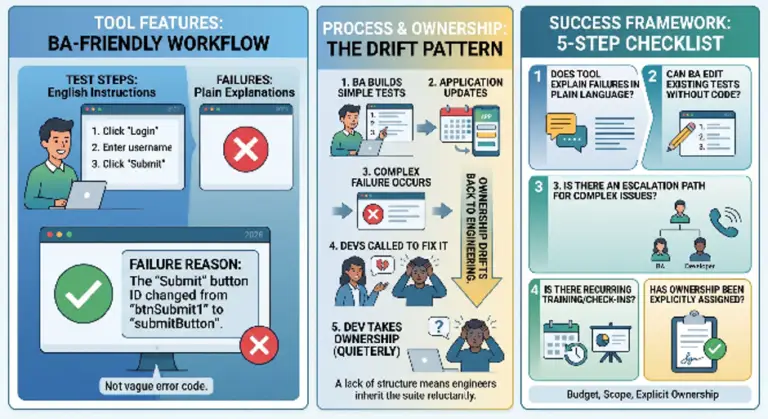
- Test steps read like plain-language instructions, not code with a friendly label (“click Submit button” rather than a raw selector string exposed as the primary interface).
- Failures explain themselves. A failed test should tell a BA what changed on the page, not just that an assertion failed – the difference between “the Submit button’s ID changed” and a generic red X.
- No environment or CI/CD knowledge is required to run or read results. If running a test suite requires understanding pipelines, branches, or deployment configuration, it’s not actually built for this audience yet.
- Visual builders are a genuine editing surface, not a demo feature. Some tools show a nice visual builder for creating a test and then quietly expect script edits for anything beyond the basics.
The common failure pattern
This is the pattern worth watching for, because it’s common enough to be almost predictable:
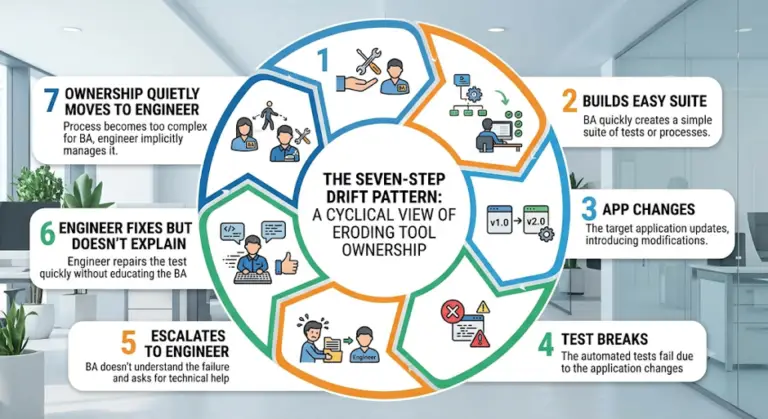
- A BA or manual tester is handed a codeless tool and told to “own automation for the team.”
- They build an initial suite – often the easiest, most demo-friendly flows first.
- The application changes. A test breaks in a way the tool’s self-healing doesn’t catch.
- The BA doesn’t have the context (or the access) to diagnose it, so it goes to an engineer.
- The engineer fixes it, but doesn’t have time to also explain the fix in a way that prevents the next handoff.
- Ownership has now quietly moved to the engineer, even though nothing was ever formally reassigned.
- Six months later, “automation” is a suite an engineer maintains reluctantly on the side, and the BA has stopped touching it.
None of this is a failure of the BA. It’s a predictable result of handing someone a tool without the operational structure to actually support ownership.
How to structure ownership so it doesn’t collapse back onto engineering
- Define an escalation path before you need it. Decide in advance what a BA should do when a test breaks in a way they can’t fix – who they contact, what information they should capture, and what the expected turnaround is.
- Budget a real training cadence, not a one-time onboarding session. Automation tools evolve, and application UIs change; a single onboarding pass six months ago doesn’t cover what’s different today.
- Scope realistically. Not every flow is a good first candidate for BA-owned automation. Start with flows that are stable, well-understood, and low-ambiguity, and expand from there rather than starting with the most complex, highest-change parts of the application.
- Make “who owns this test” explicit and visible, ideally in the tool itself or in a shared tracker – ambiguous ownership is what lets automation quietly drift back to whoever’s available.
A short checklist before committing to BA-owned automation
- Does the tool explain failures in plain language, or does it require reading a stack trace?
- Can a BA edit an existing test end-to-end without touching anything that looks like code?
- Is there a defined escalation path for issues beyond the BA’s scope, with a realistic expected response time?
- Is there a recurring training or check-in cadence, not just initial onboarding?
- Has ownership of specific tests been explicitly assigned, rather than assumed?
If the honest answer to more than one of these is “no” or “not yet,” that’s worth solving before investing further in a specific tool, not after.
FAQ
Can a non-technical person really maintain automated tests long-term? Yes, for the right scope of tests – stable, well-understood flows with a tool designed to explain failures in plain language. It becomes unreliable when the tool or the process quietly assumes developer skills for anything beyond initial test creation.
What happens when a BA-built test breaks and they can’t fix it? This is exactly where a defined escalation path matters. Without one, the fix – and often the ownership – tends to drift to whichever engineer is available, undermining the point of BA-owned automation in the first place.
How much training does a business analyst need to own test automation? Initial onboarding is rarely enough on its own. A recurring cadence – even brief, periodic check-ins as the tool and application evolve – is what actually sustains ownership over time.
Share this post if it helped!
RECENT POSTS
Guides

How To Select a Regression Testing Automation Tool For Web Applications
Regression testing is an essential component in a web application development cycle. However, it’s often a time-consuming and tedious task in the QA process.

Switching from Manual to Automated QA Testing
Do you or your team currently test manually and trying to break into test automation? In this article, we outline how can small QA teams make transition from manual to codeless testing to full fledged automated testing.

Why you can’t ignore test planning in agile?
An agile development process seems too dynamic to have a test plan. Most organisations with agile, specially startups, don’t take the documented approach for testing. So, are they losing on something?

Challenges of testing Single Page Applications with Selenium
Single-page web applications are popular for their ability to improve the user experience. Except, test automation for Single-page apps can be difficult and time-consuming. We’ll discuss how you can have a steady quality control without burning time and effort.
Why is Codeless Test Automation better than Conventional Test Automation?
Testing is important for quality user experience. Being an integral part of Software Development Life Cycle (SDLC), it is necessary that testing has speed, efficiency and flexibility. But in agile development methodology, testing could be mechanical, routine and time-consuming.

