1. Introduction: The Scalability Paradox
In modern software engineering, there is a recurring paradox: as a product matures, the speed of delivery often decreases despite increased investment in automation. This phenomenon is driven by the “Maintenance Tax”, the hidden cost of managing, triaging, and repairing existing test suites.
For enterprise-grade applications, the growth of this tax is rarely linear; it is exponential. According to the World Quality Report, organizations often allocate up to 35% of their total project budget to quality assurance, yet nearly half of that effort is consumed by maintaining legacy scripts rather than validating new features.
2. The Economics of Maintenance: By the Numbers
The cost of manual intervention in an “automated” workflow is the single greatest drain on ROI. Real-world data reveals the following impact of the Maintenance Tax:
- The Triage Drain: Industry benchmarks suggest that QA engineers spend an average of 20% to 30% of their work week simply triaging failures to distinguish between “true regressions” and “flaky tests” caused by environmental noise or minor UI shifts.
- The Scripting Bottleneck: A study published in the Journal of Software: Evolution and Process noted that for every 100 hours spent on initial script development, an additional 15 to 25 hours are required annually for maintenance to keep those tests functional.
- The Complexity Ceiling: Research from Microsoft found that as the number of test cases increases, the probability of “test smell” (poorly designed, hard-to-maintain tests) increases, eventually leading to a state where 60% of test failures are unrelated to actual product bugs.
3. Industry Precedent: How the Giants Solve for Scale
To maintain velocity, engineering leaders like Google and Meta have moved away from “Exhaustive Testing” (running everything) toward “Intent-Based Selection” and “Autonomous Healing.”
Google’s TAP (Test Automation Platform)
Google manages one of the largest CI/CD infrastructures in the world, executing over 150 million test cases daily. Their research into TAP revealed that executing every test for every change was mathematically and computationally unsustainable. They implemented ML-driven “Test Selection” to identify the “Smallest Effective Test Set.” This transition allowed them to reduce computational waste by over 30% while maintaining a 99.9% confidence level in their regression safety net.
Meta’s Sapienz & AI-Driven Testing
Meta (formerly Facebook) deployed Sapienz, an automated UI testing system using Search-Based Software Engineering (SBSE). By automating the “discovery” of test paths, Meta reported that Sapienz caught X% more bugs than manual scripting while significantly reducing the human effort required to design complex end-to-end flows.
4. The CloudQA Bridge: Democratizing Resilient Quality
While Google and Meta built proprietary, multi-million dollar infrastructures to solve the Maintenance Tax, CloudQA provides an accessible bridge for enterprise SaaS teams to achieve similar “Resilient Quality” through two core technological pillars:
Context-Aware Healing
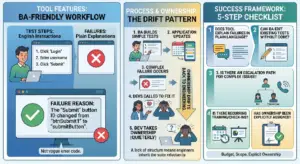
The primary driver of the Maintenance Tax is the “Brittle Selector.” Traditional tools rely on static CSS or XPath locators. CloudQA’s architecture utilizes a Multi-Point Element Identification system. Much like the predictive models used by big tech, our system understands the intent of a UI element. If the code changes, but the user journey remains the same, the test self-heals, eliminating the manual triage cycle.
Reducing the “Scripting Tax” with AI Smart Recorder
By moving from manual step-recording to Natural Language Intent, CloudQA shifts the engineering focus:
- Traditional Manual Path: ~15 minutes per test (Recording + Refinement + Maintenance).
CloudQA AI Path: <1 minute per test (Prompt + Autonomous Execution).
Conclusion: Breaking the Velocity Ceiling
The empirical evidence from industry leaders like Google and Meta, combined with broader market data, points to a singular reality: Manual script maintenance is the “silent killer” of software velocity. As applications grow in complexity, the traditional approach of “record-and-fix” creates a scalability paradox where more automation leads to less agility.
By shifting the paradigm from Static Scripting to Intent-Based Resilience, CloudQA allows enterprise teams to bypass the exponential growth of the Maintenance Tax. Implementing context-aware healing and AI-driven synthesis isn’t just about technical efficiency; it is about reclaiming the 30% of engineering bandwidth currently lost to triage and repair. In the era of high-frequency delivery, the goal of quality assurance is no longer to merely “find bugs,” but to provide a high-speed safety net that scales alongside your vision—turning QA from a bottleneck into a strategic competitive advantage.
Frequently Asked Questions (FAQ)
Q: What exactly is the “Maintenance Tax” in test automation? A: The Maintenance Tax refers to the ongoing time and resource expenditure required to update existing tests whenever the application’s UI or code changes. In traditional setups, this often consumes nearly 50% of a QA team’s total effort, stalling the creation of new tests.
Q: How does “Context-Aware Healing” differ from traditional self-healing? A: Traditional self-healing often relies on simple fuzzy matching of selectors. CloudQA’s Context-Aware Healing uses Multi-Point Element Identification, analyzing the semantic purpose and metadata of an element. This means if a button’s ID changes but its role in the user journey remains the same, the test survives without manual intervention.
Q: Does moving to an “Intent-Based” system mean I lose control over my test logic? A: Not at all. Intent-Based testing allows you to define the what (the mission) while the AI handles the how (the navigation). You still maintain full control over assertions and validation criteria, but you are freed from the manual grind of defining every intermediate click and wait-state.
Q: Can these principles be applied to legacy test suites? A: Yes. While legacy suites are often the primary source of the Maintenance Tax, transitioning to a resilient architecture like CloudQA allows you to gradually replace brittle scripts with autonomous tests, effectively “refactoring” your quality layer without stopping production.
Q: How can I access more advanced testing features like these? A: Why let testing hold you back? Explore the shift to active resilience today. You can register to access our Test Case Generator, Email Testing tool, and the comprehensive Codeless QA Automation Suite to begin eliminating your maintenance debt immediately. Register for Free