The ROI Case: Moving Beyond “Cost Reduction”
When pitching AI automation to the board, the instinct is to focus on headcount reduction. This is a mistake. The true ROI of AI in testing lies in Opportunity Cost and Velocity.
1. Reclaiming Developer Time
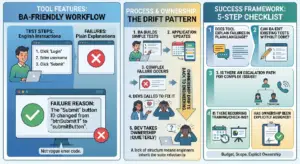
In a traditional setup, when a test suite is flaky (failing intermittently due to brittle scripts), your most expensive resources, Senior Developers, spend hours debugging the test rather than writing feature code.
- The AI Impact: Self-healing mechanisms reduce false positives by up to 80%. If your team saves 10 hours of debugging per week per developer, you have effectively “hired” a new engineer for every four you already have, without the headcount cost.
2. The Cost of “Escape Defects”
The cost of fixing a bug grows exponentially the further it gets in the lifecycle. A bug found in production is 100x more expensive than one found in design.
- The AI Impact: By using LLM-generated test cases during the requirements phase (Shift Left), you catch logic errors before a single line of code is written.
Strategic Implementation: Where to Start?
You cannot boil the ocean. Implementing AI across the entire stack overnight will lead to chaos. A tiered approach is necessary.
Phase 1: The “Low Hanging Fruit” (Regression)
Start with your Regression Suite. These are the repetitive tests that run every night. They are often the brittlest.
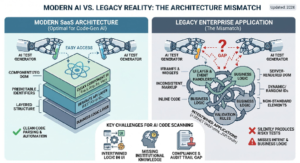
- Action: Replace legacy Selenium scripts with an AI-driven platform like CloudQA that supports self-healing. This stabilizes your pipeline immediately and builds trust in the technology.
Phase 2: Democratization (The “Quality Culture”)
Traditionally, automation was siloed with SDETs (Software Development Engineers in Test). This created a bottleneck.
- Action: Adopt low-code AI tools. Empower Product Managers and Business Analysts to generate test cases using Natural Language Processing. When the person who defined the feature can also automate the test for it, quality becomes a shared responsibility. This is explored further in our guide to Low-Code AI.
Phase 3: The New Frontier (Generative Validation)
Once your functional testing is stable, move to the complex layer: Testing your own AI features.
- Action: If your product uses chatbots or recommendation engines, you need probabilistic testing frameworks. As detailed in our AI Apps Testing paradigm, you must implement safeguards against hallucinations and bias, which are now board-level risks.
Reshaping the Org Chart: The AI-Ready QA Team
The fear that “AI will replace testers” is unfounded, but it will replace the “manual executor” role. As a leader, you need to upskill your organization.
The Skills Gap
You need fewer people who can “write Java for Selenium” and more people who possess:
- AI Literacy: Understanding how LLMs work, where they fail, and how to prompt them.
- Data Fluency: The ability to manage the massive datasets required for AI-driven testing.
- Strategic Analysis: Moving from “Did it pass?” to “Is this the right user journey to test?”
Hiring Tip: Stop looking for “Automation Scripting” as the primary skill. Look for “Quality Architecture” and “System Design” skills. The AI will write the script; your human needs to design the architecture.
Managing Risk and Governance
With great power comes great liability. AI tools consume data. As an engineering leader, you are the guardian of data privacy.
- Data Leakage: Ensure your testing vendors (like CloudQA) do not use your proprietary data to train their public models.
- Compliance: If you use generative AI to create test data, ensure it generates synthetic PII (Personally Identifiable Information) and does not inadvertently scrape real customer data from your production logs.
Why CloudQA is the Leader’s Choice
We designed CloudQA not just for testers, but for the leaders who manage them. We solve the visibility and stability problems that keep VPs up at night.
- Dashboards that Matter: We don’t just show “Pass/Fail.” We show “Health Trends.” You can see if your application is getting more stable or more brittle over time.
- Infrastructure as a Service: You don’t want to manage a Selenium Grid. We handle the infrastructure, allowing you to scale from 10 tests to 10,000 tests purely based on demand.
- Future-Proofing: By integrating advanced CI/CD best practices, we ensure your stack is ready for whatever technology comes next.
Conclusion
The window for “wait and see” has closed. AI in testing is now a mature capability. The organizations that adopt it will release faster, cheaper, and with higher confidence. Those that do not will find themselves buried under the weight of technical debt and maintenance costs.
The transition is a leadership challenge, not a technical one. It requires vision, investment, and a willingness to change the culture of quality.
Frequently Asked Questions
Q: How do I measure the success of an AI testing initiative?
A: Look at three metrics:
- Defect Escape Rate: Is the number of bugs reaching production dropping?
- Cycle Time: How long does it take to go from “Code Commit” to “Verified Deploy”?
- Maintenance Effort: Are your engineers spending less time fixing broken scripts?
Q: Is AI testing expensive to implement?
A: The upfront license cost might be higher than open-source libraries (which are “free”), but the Total Cost of Ownership (TCO) is significantly lower. Open-source requires expensive engineering hours to maintain. AI platforms drastically reduce those hours.
Q: Can AI help with security testing?
A: Yes. AI can perform “Fuzz Testing” at a scale humans cannot, throwing millions of random inputs at your API to find vulnerabilities. However, this should complement, not replace, professional security audits.
Related Articles