The $112 Billion Watershed: A Market in Hyper-Expansion
As we navigate through 2026, the software testing landscape has officially shifted from a peripheral “support” function to a primary engine of business resilience. What was once a $55.8 billion market in 2024 is on an aggressive trajectory to reach $112.5 billion by 2034.
This isn’t just a quantitative increase; it’s a structural transformation. We are seeing a definitive reallocation of capital toward automation-led segments (14.5% CAGR) and IoT testing (31.1% CAGR). Large enterprises now allocate over 25% of their total IT budgets specifically to quality efforts, with the BFSI (Banking, Financial Services, and Insurance) sector leading the demand as it attempts to mitigate the existential risks of service failure in an increasingly digital economy.
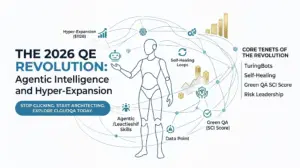
The Agentic Paradigm: TuringBots and the Death of the “Flaky Tax”
By 2026, AI is no longer a experimental “nice-to-have.” It is a standard operational partner. The industry has moved beyond scripted automation, which historically plateaued at 25% coverage, into Agentic Orchestration.
The rise of “TuringBots” (autonomous agents) has collapsed traditional testing cycles from days to approximately 2 hours. Unlike legacy tools, these systems don’t just follow a script; they possess Agentic Intelligence. They can review code changes, self-heal brittle scripts, and make day-to-day execution decisions with minimal human intervention.
Key Performance Gains:
- Productivity: Organizations embedding GenAI report a 40% increase in test coverage and a 10x improvement in overall productivity.
- Maintenance Reduction: Self-healing scripts have demonstrated a 95% reduction in manual maintenance.
- Defect Detection: In regulated sectors, AI-native platforms have led to a 90% improvement in pre-production defect detection.
Integrated Quality Loops: Dissolving the Barriers of Shift-Left and Shift-Right
The historical silos between “Shift-Left” (testing early in development) and “Shift-Right” (testing in production) have dissolved into a single, continuous Integrated Quality Loop.
In 2026, 86% of organizations report that testing teams have a decisive voice in release readiness. The focus has moved from simple validation to Continuous Experience Intelligence. By analyzing real-world production telemetry, used by 94% of firms, QA systems now “evaluate behavior” rather than just “checking correctness.”
Strategy | Implementation Standard (2026) | Strategic Value |
Shift-Left | Contract Testing & TDD | Validates interfaces early; 26% BDD adoption. |
Shift-Right | Canary Deployments | Automated rollbacks based on real-time health. |
DevSecOps | Zero-Trust Pipelines | Security checks integrated into daily CI/CD. |
Technical Frontiers: Synthetic Data and the Microservices Crisis
The shift toward microservices has introduced a “testing crisis.” Distributed systems communicate through complex webs where a single request may touch dozens of services, making traditional end-to-end (E2E) tests slow and expensive.
To solve this, 2026 has seen the rise of Synthetic Data Generation. By creating data that mirrors real-world distributions without exposing PII (Personally Identifiable Information), teams can reduce test data preparation costs by 70%.
Furthermore, Chaos Engineering has become standard practice. Instead of waiting for failures, teams proactively simulate network latency and pod crashes in staging environments to ensure system resilience. Contract Testing now independently validates service interfaces, reducing environment complexity by over 80%.
The “Professionalism Premium”: Talent in the Era of the SDET
The role of the “Manual Tester” has largely evaporated, replaced by the Quality Architect and the Software Development Engineer in Test (SDET). While there is a “Panic Majority” (65.6%) concerned about job security, the data suggests a different story: those who embrace AI report significantly lower job anxiety.
We are seeing a Professionalism Premium, where strategic skills command massive salary increases:
- Communication Skills: +36.1% premium.
- Risk Assessment: +10.6% premium.
- Leadership: +7.7% premium.
Conversely, basic automation scripting is being devalued (-13.8%) as AI takes over the execution grind. The human value in 2026 lies in exploratory testing, UX empathy, and ethical auditing.
Green QA: Sustainability as a Performance Metric
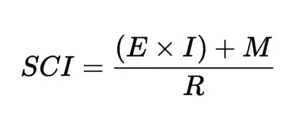
Sustainability is no longer a corporate afterthought; it is a core performance metric. Testing pipelines in 2026 are being optimized for energy consumption using the Software Carbon Intensity (SCI) score.
The SCI score is calculated as follows: