Most quality assurance content details theoretical ideals. This article reviews what software engineering organizations are executing in production workflows by compiling the latest empirical data from comprehensive global studies like the Capgemini World Quality Report, the GitLab DevSecOps Report, and Google Cloud’s DORA research. These findings isolate the exact structural attributes that separate high velocity delivery pipelines from teams stalled by severe testing bottlenecks.
Finding 1: Test Maintenance Belongs as the Primary Operational Bottleneck
The common assumption is that deployment failures stem from insufficient test coverage. The empirical data reveals a different reality. The Capgemini World Quality Report shows that 53% of organizations identify the rapid frequency of user interface modifications as their primary quality assurance bottleneck.
Large test suites frequently slow release cycles down more than lean, stable alternatives. A high ratio of broken tests to working scripts creates a loop where developers spend more hours repairing old code than shipping new features. High velocity teams prioritize test reliability over sheer test volume.
What this means for your team
Before expanding your test repository, audit what percentage of your suite passes consistently. A compact, stable testing layer integrated into your pipeline will outperform an expansive, fragile framework every time.
Finding 2: Legacy Scripted Frameworks Hit a Strict 25% Automation Ceiling
Engineering organizations under intense delivery pressure are running into an architectural barrier with traditional testing tools. Forrester research reveals that companies relying on manual script authoring hit a rigid ceiling where they plateau at just 25% test automation coverage.
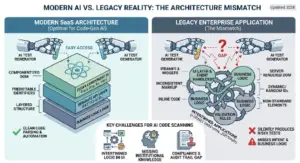
Scripted frameworks cannot scale efficiently alongside continuous deployment schedules. Every user interface update fractures legacy script structures, causing maintenance tasks to accumulate until they block releases. Modern autonomous and codeless testing platforms are expanding precisely because they use intelligent tracking to break through this 25% coverage ceiling without scaling your engineering headcount.
What this means for your team
If your shipping frequency is increasing, calculate the true long term maintenance cost of your scripted framework. Script upkeep expenses typically compound faster than technical leaders project, capping your total automation potential.
Finding 3: The Dangerous Disconnect Between Pipeline Coverage and Quality Gates
This data point highlights a major structural vulnerability across modern software organizations. Pages of documentation celebrate continuous deployment, yet the numbers expose a massive execution gap: the GitLab Global DevSecOps Report reveals that while 74% of development teams use automated continuous integration pipelines, only 26% enforce automated quality gates that block code deployments on a test failure.
Running automated tests within a pipeline provides false security if a failure fails to stall the build. Suites configured merely to send notifications rather than enforce quality boundaries do not protect production environments. The engineering teams with the lowest post release defect escape rates ensure that a single regression failure stops the deployment sequence automatically.
What this means for your team
Audit your pipeline configuration. If a failing regression test simply issues a message alert instead of blocking the production build, you have an infrastructure enforcement problem, not a testing problem.
Finding 4: Explicit Suite Ownership Dictates Long Term Reliability
Quality automation outcomes depend significantly on clear human accountability. The Google Cloud DORA Accelerate State of DevOps Report establishes that teams with well-defined code and test ownership maintain significantly higher pipeline stability and see lower change failure rates compared to teams with diffuse or completely shared quality responsibilities.
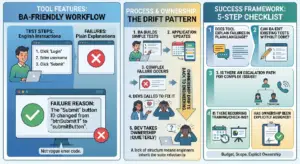
Tooling choices cannot compensate for a lack of explicit ownership. Without named engineers responsible for specific test domains, failing scripts accumulate and trust in the automation system erodes. Teams eventually bypass the testing layer entirely under tight roadmap pressures.
What this means for your team
Assign test domain accountability the same way you manage code base ownership. Route specific failure alerts directly to the responsible engineers and include test health indicators in regular architectural reviews.
Core Operational Attributes Shared by High Velocity Teams
Across top performing engineering groups, teams share five distinct execution habits:
- Automation routines trigger natively on every code commit.
- Automated quality gates block failing builds from entering production environments.
- Test suite domains belong to specific engineers rather than the general team.
- Unstable or flaky tests undergo immediate repair or removal within the active sprint.
- Test suite health metrics are reviewed during regular engineering cadences.
None of these elements are dependent on specific tooling choices; they represent fundamental operational hygiene.
Integrating CloudQA into Production Infrastructure
CloudQA targets the specific maintenance bottleneck that slows down a majority of engineering organizations. The underlying self healing engine removes the manual upkeep required to preserve test accuracy, matching the explicit operational requirements of teams moving toward high frequency deployment models.
For engineering organizations utilizing continuous integration pipelines without active quality gates, our native platform connections make it simple to convert test failures into hard deployment barriers. The platform delivers maximum strategic efficiency for teams where non developer quality assurance practitioners manage testing and deployment velocity outpaces internal engineering capacity.
Next Step
If these findings resonate with problems your team is experiencing, the practical next step is to map your current QA setup against the five characteristics the fastest teams share.
Start a free 14-day trial to connect to your pipeline in under an hour with zero scripts required.
Book a 30-minute QA audit call to map your current setup against these data patterns with an honest assessment of your pipeline gaps.